reabc/Legacy Tamanend III Internationalizing Struggle - Nathaniel Lee/Legacy Tamanend III Internationalizing Struggle - Nathaniel Lee.pdf
Web PDF • Imposed PDF• Raw TXT (OCR)






![£y Thompeon aminged ©© move the place ‘mecting fom the Stte House to Carpenter’s Hal, where, the Continertal Congress more easily be ontrolled by th rdicals. i ‘Meanwhile, in New York City, on Apeil 23%, 1775, Ismac Sears ld the b n sezig the led the mob i desroying the preses and Coguenkeghion addressed Congress and o send assistance in the ministers and a biackomith among the Lenspe a Ohio. The sieady bod thes, but he was ient ‘Wooing the more conservative snd racist Souter and New England delegates by asauring them that the “hesthen Indians” ] e Yrk N Yok, 190, All, Ol . by ‘-mm-wm»-.umm o 14 12 13 wasted 10 be “civiized™ This would caus him wouble beck in Ohio with both Moravians, who consideed the Delawares be ‘their Iodians” and the Lenax tradionaliss, who thovgle. there was quin enough “civiliing” going on aready, but | was well acoepted by the delegaes o th Continenta Congress. Congress appointed George Morgan t be it special Intian Agent and empowered him u ring the Ohio nons o an allance whl the United Colonies. Eloquent n the lngusg of wampum diplomacy, and knowledgeabl in Lenspe hisory and custom, Morgan ve ‘wellreceived by the Lenspe Grand Counci ‘which adopted i and gave i the rank o a Lenape chi, along with the mostbonorabh ‘ame of Tumanend, in recogaiion of th imporant message of pesce he troug an e llisnce he was stempting 0 forge, whic v viewod as arevewal ofthe Grea Trety. In Sepembe of 1778, the Continers Congres, through the Treaty of Pisburg formally invited. the Delawares 10 Join th Amercan confideraton,and i was suggeste that they might, “....invite any other tribe Who have been frieads to the interests o the United States, o0 join the presen conederntion, and to form a state whereo the Delaware nation shall be the bead, ams have representaton ia Congress™* “This step was aborted, however, by th assasinaton of White Eyes, while be wa serving as Lt Colone i the Continenta Army, and the Goadenbutien Massacre ‘where almost a hundred pacifist Moravia. Indians were executed by the Washingto County Milia, all_tenants of Georg ‘Washington. In the end, despite the inten of the Congress, General Washingto " Treaty with the Delawares o Sepiember I 17,70t 13,](Legacy Tamanend III Internationalizing Struggle - Nathaniel Lee 13.png)


![sington seized on this as an excuse 10 alize the state miliias in Pevosytvania, land, New Jersey and Virginia and them agaiast the rebels in October of . The farmers did not tempt 1 rsist, ‘ough some moved on the Kentucky and ressce), and those who_wero aresied convicted of ireason®® were laier oned by Washingion. i ] ] i ock on the city through control of the only two banks, the Bank of New York and the](Legacy Tamanend III Internationalizing Struggle - Nathaniel Lee 20.png)


![2328 > CERE m [ r.m.mu MWM 225 Sk, I sty Em_uamhm g ] mwmmmwmmfimh i mmm.m_mmm R, il kil mw_r i 2 mm wm nnmm— i muum mMm w- jt il mmm il wwm iih it ! m.wxmmrzh Mw gl 3 It thgehate SRR oL i mmwmmmr: .m_fi i mm i ol e](Legacy Tamanend III Internationalizing Struggle - Nathaniel Lee 27.png)

![better serve their needs. But the cause of social Justioe has yet 10 wina final victry. The New Word Oder represents the highest sod final suge of capialist corporate utter consempt for the rights of the common ‘people and uiter disegard for the fitwre existence of mankind. Their sole concern s their_sccumulation of weakh and the ‘maximization of their profits. ‘Now more than ever, we need 10 reflect on. the legacy of Tamaneod mnd dedicate ouselves 1o be his worhy sons and danghters. IFhistory shows us amything, it is that the power of the people united is the reatest power on earth. The Tammany Society, the “Workies” and the “Loco Focos,” each contributed t and passed on the legacy of liberty. The Red Heart Wamrors Society honors _these. ‘ancestors, along with our American Indian ‘warrior sncestors ad ll who bave mutured the tree of berty. 0 (o The Wanpun, Vol 1, No 1, Speing 1996]](Legacy Tamanend III Internationalizing Struggle - Nathaniel Lee 33.png)










THE LEGACY OF TAMANEND III:
THE ST. TAMMANY SOCIETY & MAYDAY
By Tom Big Waric
Race, Ethnicity and Nationality in Americc
By Tom Big Warrior, June 1, 2003
INTERNATIONALIZING THE STRUGGLE
by
Nathaniel Lee
I'HE LEGACY OF TAMANEND IiI:
THE ST. TAMMANY SOCIETY & MAYDAY
By Tom Bi Waricr
The name of TAMANEND s hed i th highsst veneration among the Indians. Of
all the chiefs and great men which the Lenape nation ever had, he sands
Joremost on th ls. But aithowgh many fabudows tories are circuated abous him
“among the whites, bu lnle of hs real hisory i knovn. The misfornunes which
have befallen some o the mostbeloved personages among ihe Indians since the
Europeans came among them, prevent the survivors from incging in the
pleasure ofrecaling o mind the memory of her irues. .
All we know, therefors of Tamanvend s, that ha was an ancient Delaware chi.
who never had hi equal, He was in the highest degree endowed with wisdom,
virtue, prucence, charky, afabilty, meekness, hospitaily, in short with every
good and nobla quaity that @ hiaman being may possess. Ho was supposed 0
Rave intercourse with the great and good Spirit; for he was @ stramger fo
everything that I bod.
John Heckewelder, History, Manoers, aad Castoms of the Iodian Natioss
The legacy of Tamanend Il is as much an avoided subject by whies now as it was by
Hockeweder's Lenape comemporaces, though & is 1ot & desk to wvokl saress by
“emembering lost greatness. It is simply that American history has been white-washed over
ot cxaen i oo ot s e the Ptron Sl of America anthe Common Mo s
et aay legacy of noe.
{n fac,th fac that “St. Tammany,” a deceased Indian chief, had such gret influence over
the “Founding Fathers,” or af least the mob of “common people,” who were demanding
Libery, Equality and Brotherhood fromthe new nation they were founding, bows svay a ot
of whitewash, when you start o think sbou . It puts the American Revoluton and i egacy
oo different perspective.
1
John Heckerwelder, & Moravian missionary fom Bethlchem, Pennsylvania, who spent th better
‘et ofthirtyyearsliving among the Lenapes in wester Peansylvania and Ghio, wrot thar:
The e of s preat man cxended cvn snng the whis, Who Bivicaied munerons
Igends nepectig him, whh | never head, hower, fom e mouth of s ndin, wnd
Berkre beee (o be s In e Revoutcary e, bis eusiatic nirersdubbed
i s, d b was exblshd under e mame of S. Tammaay, he parn sain of
Amerc, His e wasnsrted nsome calendar,md s sival was celbrtdcn the st
‘o May i every year. On tha day mamcrus sty f bis vorics velked togethr I
procesion trough the s of Phildephi, ok b decorted with bucs'” al,end
104 handscm s plac: ko owe wbich ey calld the Wigwam, wher, e
g i oo psch b ben delverd, ad he Calmet of peace d fendshiphad
o Gl smoked, they spcat e day n vy and i, Afler dler, nla dancs were
permod an the gren . fout of the wigwam, the calmet vas g smcked, 1 e
‘company epersed.
The ssocaon e sl some years st pescs, whenthe public piced owner o the
wigvam, who emerouly hd e K every year R the hosor of his v o, having
il under rmisrune, bl propery s sl 0 sty s crons... ke that te,oher
sociaies bave been e n Pladelpia, Now Yoek, md 1 belve n e fowns I the
Uon,wder th name . Tammany: bt th prncpe it of thse asocaion beng.
oy e, ey have o much of e charm wich was tached 0 the rgial socety of
S Temmany.. Thee policl socece, owever, alfc 0 presrve: Indan ims hee
rpoization 4 mectings. They are prisided ovr by & Grand Sache, tnd ek o
‘ffrs e desgaied b i des. They meet o h “wigwam,” s th “going down of
e "t ot of mows, plas, fowes, & Thelr distogusbing appelatn ks
‘hvays “The Tammaay Sociy™
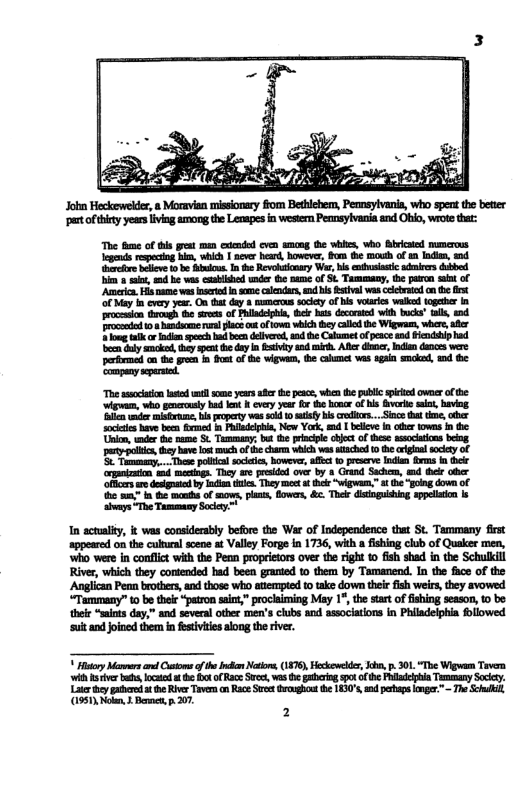
1n actaliy, it was considerably before the War of Independence that St. Tammany first
‘appeared on the cultural soene at Valley Forge in 1736, with a fishing club of Quaker men,
‘who were in conflct with the Penn proprietors over the right 1 fish shad in the Schullili
Rver, which they contended had been granted o them by Tamanend. In the fice of the
Anglican Penn brothers, and those who aiempied to take down thir ish weirs, they svowed
“Tammany” to be thele “patron saot,” prociaiming May 1%, e start of fishing season, 1o be
their “smiots day,” and several other men's clubs and associations in Phiadelphia llowed
‘suit and joined them in fesiviries alog th river.
Hitory Marrs i of e I Notors, (187), Heckoweds, ko, . 301 “The Wigwam Tovera
‘it e b, ocatod e 0t o Race S, was h arin 9ot ofhe Pl TunanySocey.
Later ey pateeda e River Torvercn Race St drghs e 830, sn g onger:”~ The S,
1951 Nol, 1 Bemct, 207
2
Mayday had been a Celtic and Roman
holiday in Europe, and may also have
been @ continuation of the Lenape
tradition of holding a Spriog festival, the
Mee-sing-kin'te-ka (Gamekeeper Spicit's
Dence) in hooor of the Mee-sing-haw-
lee-lum ot Mesing ', the masked Manitou
central to the Lenspe Big House religion.
A feature of the mid-18* cemtury St.
Tommany's Day was the coming round of
the “Sainted Chief" o private homes on
the eve of the celebration dressed in full
regalia, whooping and dancing sbout, to
‘the fright and amusement of the children.
The “Chief” would be given treats and
then move on 10 the next home, much as
the masked “Mesing'w” would visit the
‘wigwams of the Lenape prio to the Mee-
sing-kin'te-ka.
The name Tamanend means the “Affsble
One,” and Tamanend the Third certainly
lived up to this reputaton. Not only did he
meke and keep the Great Peace of
Shackamwxon with the “Children of
Broter Onas” (Wm. Pemn), but he
rejcted Iroquois attempts 10 goad the
Leoapes into supporting ther “Twenty
Yeus War” agaiost New France and it
Indian llies.
In 1687, & Mohawk spokesman appealed
1o Pennsylvania’s Governor Dongan for
belp in persuading the Lenapes 1o send
‘wastiors to Iroquois, saying: We ask for
help, much of it, and in a hurry. Where
we run? There is a great crowd of-
who would pursue us everywhere
anyoay?’
Speaking for his fellow Lenape sakemas,
(Mohocksey and" Tamanend), Chief
* ~Permyivania ndns e e Iroquote.”
Jemings, Pranci, in Beyond the Covenart Chaln
0907, i, Dol K & e . Mol
Philadelphia, with guns, tomabawks and
bows in hand, 1o defend theie pacifit
Quaker brothers. It was only with
Tammany. Second Thirteen Serjeants drest
in wite each with a bow in his left hand
and thirteen arrows in his right. Thirdly
13
o
it
i
by grating politicians,the ten successi
chiefs whose names were deliberate
forgotten. These were followed by a seric
‘varchouses of the ich 0 i the poor o the ¢
nd e surving Contnenal ' Army. L
wagonloads of com rom the Onelda Idlans &
e Leigh Valley kept the army siive st Val
Fore.
e Red ek, (199, McCuche, D
o g0 sekemas, The et One, The
Blameless One, Constant Love, House
Maker, Chastely Loving, Long Lineage,
Big Teeth, and Olumapi (“History Man"),
who is credited with the innovation of
keeping the written record of the Wallam
Olum. During this period, the Lenape
Ancestors are believed 1o have adopted
the Big House religion.
Following this time in the Pacific
Northwest, the Leaspes continued their
southward _migration im0 the Great
Plaseau region, which abounded with wild
frits, roots and salmon-filled rivers, and
the Lenape became more mumerous and
prospered, unti a great drought came and
forced the people to seek the high pains
in search of game, and they crossed the
Rocky Mouataing into the new country.
However, the people were deeply divided,
and for some generations, no one could
il th rol of sakema. Hardened One, and
‘after i The Denouncer, red to eniorce:
unity, leading 10 splits and fracturing of
the naton, with soms Lenape (Algonkian)
speaking people breaking off to o their
own way.
Tamanend 11 was the chief sakema after
the people reached the Mid-Atlantic
region, the homeland of Lenape hoking.
He is mentioned in lines 22 and 23 of
Book V ofth Wallam Otum:
Tamanend the Second
\Then was the sachem,
‘Making peace with al,
mumnmuup-qe,-a
Tamaneod I1's teaure is believed t have
begun around 1450 or a fittle earlier. After
Kensingion section of the Cty of
Philadelphia
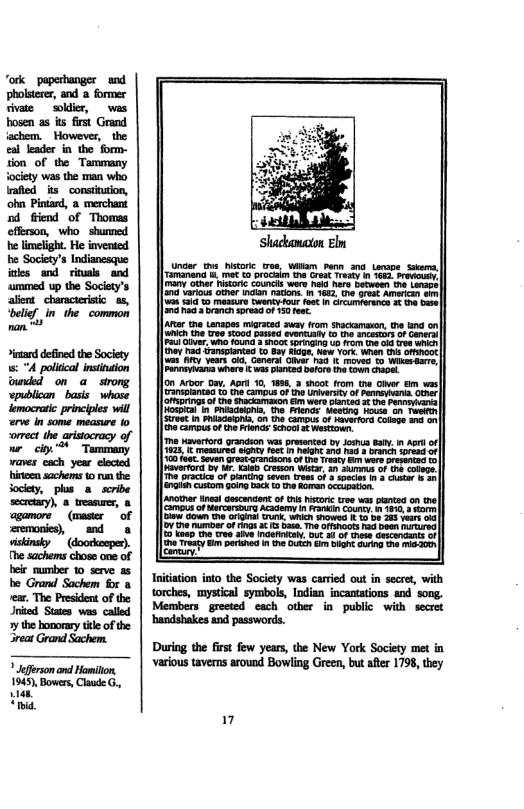
The stame of William Penn siop the
Treaty was made between Penn and
Tamanend II, but the tree has since died
it W
wmm mw o
) mfl mm.
wfi bl
[ B R |
i _r il |1
i i, il |
5 Er_mw T I
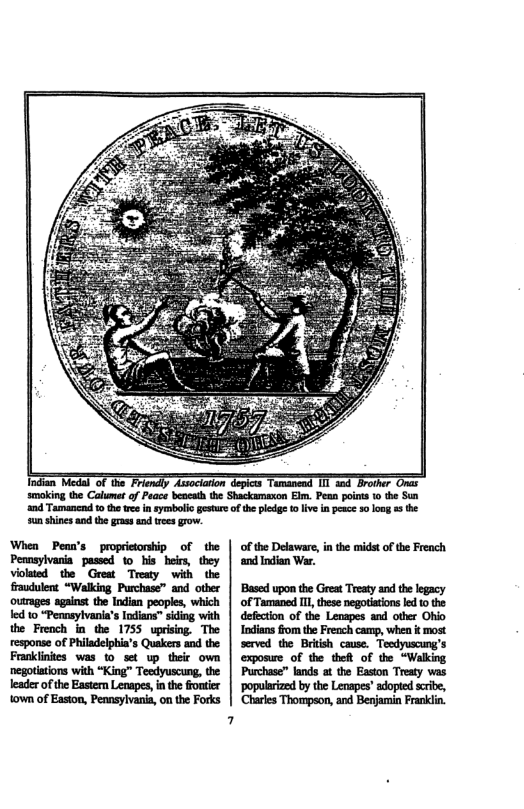
smoking the Calumet of Peace beocath the Shackamaxon Elm. Pean poins 1 the Sun
‘and Tamancnd 0 the re in symbolio gsture of the pledgs o live in pece 30 long s the
sun shines and the gras and trees grow.
of the Delaware, in the midst of the French
‘and Indian War.
‘Based upon the Great Treatyand the legacy
of Tamaned I thse negotiations ke 1 the
defection of the Lenapes and other Ohio
Indians from the French camp, when i most
served the Britsh cause. Tocdyuscung’s
exposwre of the thett of the “Walking
Purchase” lands at the Easton Treaty was
‘popularized by the Lenapes' adopted scribe,
Chartes Thompson, and Benjamin Frankli.
9
In 1747, the Schuylkill Fishing Company
presented a cannon to the Association
Battery stamped with the words Kwanio
Che Keeteru, phrase mributed to
Tamanend _meaning: “THIS IS MY
RIGHT, AND [ WILL DEFEND IT"
“They planted by your care? Nol your
oppressions planted them in America.
They fled from your tyranny, 1o a then
wncultivatéd and inbospitable country,
here they exposed themselves (0 almost
all the hardships to which uman nature
" From whan, along with Joho Wilkes, the radical
mayor of Loadon, the Pennsyivaia tova. of
Wilkes-Barr derivd s name. ' was ounded by
s liable, and...they grew up by your
neglect of them. As soon as you began to
care about them. that care was exercised
by sending persons 1o rule them in one
depariment " or _another, who _were.
perhaps, the deputies of deputies 1o some
members of this House, sent to spy out
their_ibertie, o misrepresent _their
actions, and o prey upon them—men
Whose behavior on many occasions has
caused the blood of those SONS OF
LIBERTY o recoil within them™”
Almost overnight, the radical circles in the
different colonies grasped at & common
“Wih the regular governments all but
extinguished, the Sons of Libety steadily
lightened. their_control...they kept_the
upper hand. They acied, of course, more
arbitrarily than the reguiar government
would have dared 1o do: they seised
private mail,resticted the freedom o the
press, and terrorized iheir enemies
" Pictotal Feld Book o the Reoluion, (1860),
Losing, Benson 1 p. 162-163.
i
without mercy. But thi is oly 1o sy that
they were beginning a.revoluton. They
has seized the power which once had
belonged 1o the royal governments, and
they were prepared 10 keep W by foir
means o foulunil theirend, the deeat of
the Stamp Act, was accomplished. "
one of the two most dangerous radicals in
‘New York by British inteligence services.
When the Stamp Act was repealed in
1766, he was proclaimed a “general” by
the mob and given a cannonade saute.
smuck up in the night and cut down the
pole, where the rebels gathered t0 renew
The Stamp Aet Criis . 355.
their commitment to the fight for liberty.
On one occasion, they fired their guns into
the tavern, which the local Sons of Liberty
used as thei nightly gathering spot.
Each time the Liberty Pole was replaced
10
"
Civil_and Religious Liberty, as_thel
Tutular Saint; and anmually assembled o.
a fixed Day, to commemorate him. Th
Natives of this flourishing Provinc
determined 1o follow so laudable
Example, for some Years past, hav
adopted a Great warrior, Sachem, an
Chief, named S TAMMANY, a fou
Friend 10 our Forefathers, o be th
tutular Saint of this Province; and hav
hitherto, on the FIRST OF MAY, done th
accustomed Honours 10 the Memory of 50
great and celebrated a Personage. And for
the same Purpose. you are requested 10
meet the CHILDREN and ASSOCIATED
'SONS of St. TAMMANY on Saturady next,
i the House of Mr. James Byrn, to dine
together, and form such useful charitable
Plans, fo the Relief of ll In Distress, as
shall then be agreed on’*
Adams of Philadelphia.” He was. the
Secretary of the Contineotal Congress, and
the Chiefs bost.
‘Thomson was Ben Franklin's next door
‘neighbor, and the principle founder of the
Sons of Liberty in Philadelphia in 1763. Jt
‘was he who organized the First Costineatal
" Chares Thomson: Phiadelphia’s Own Som
Adams, Randal, Willrd S, frm T Founding
Cinp s,
hid
£y
Thompeon aminged ©© move the place
‘mecting fom the Stte House to Carpenter’s
Hal, where, the Continertal Congress
more easily be ontrolled by th rdicals.
i
‘Meanwhile, in New York City, on Apeil 23%,
1775, Ismac Sears ld the b n sezig the
led the mob i desroying the preses and
Coguenkeghion addressed Congress and
o send assistance in the
ministers and a biackomith
among the Lenspe a Ohio. The
sieady bod thes, but he was ient
‘Wooing the more conservative snd racist
Souter and New England delegates by
asauring them that the “hesthen Indians”
]
e Yrk N Yok, 190, All, Ol .
by
‘-mm-wm»-.umm
o 14
12
13
wasted 10 be “civiized™ This would caus
him wouble beck in Ohio with both
Moravians, who consideed the Delawares
be ‘their Iodians” and the Lenax
tradionaliss, who thovgle. there was quin
enough “civiliing” going on aready, but |
was well acoepted by the delegaes o th
Continenta Congress.
Congress appointed George Morgan t be it
special Intian Agent and empowered him u
ring the Ohio nons o an allance whl
the United Colonies. Eloquent n the lngusg
of wampum diplomacy, and knowledgeabl
in Lenspe hisory and custom, Morgan ve
‘wellreceived by the Lenspe Grand Counci
‘which adopted i and gave i the rank o
a Lenape chi, along with the mostbonorabh
‘ame of Tumanend, in recogaiion of th
imporant message of pesce he troug an
e llisnce he was stempting 0 forge, whic
v viewod as arevewal ofthe Grea Trety.
In Sepembe of 1778, the Continers
Congres, through the Treaty of Pisburg
formally invited. the Delawares 10 Join th
Amercan confideraton,and i was suggeste
that they might, “....invite any other tribe
Who have been frieads to the interests o
the United States, o0 join the presen
conederntion, and to form a state whereo
the Delaware nation shall be the bead, ams
have representaton ia Congress™*
“This step was aborted, however, by th
assasinaton of White Eyes, while be wa
serving as Lt Colone i the Continenta
Army, and the Goadenbutien Massacre
‘where almost a hundred pacifist Moravia.
Indians were executed by the Washingto
County Milia, all_tenants of Georg
‘Washington. In the end, despite the inten
of the Congress, General Washingto
" Treaty with the Delawares o Sepiember I
17,70t 13,
!
|
tional - Convention
pened on July 15*, and
tassumed the power of
State government
mmediately, though
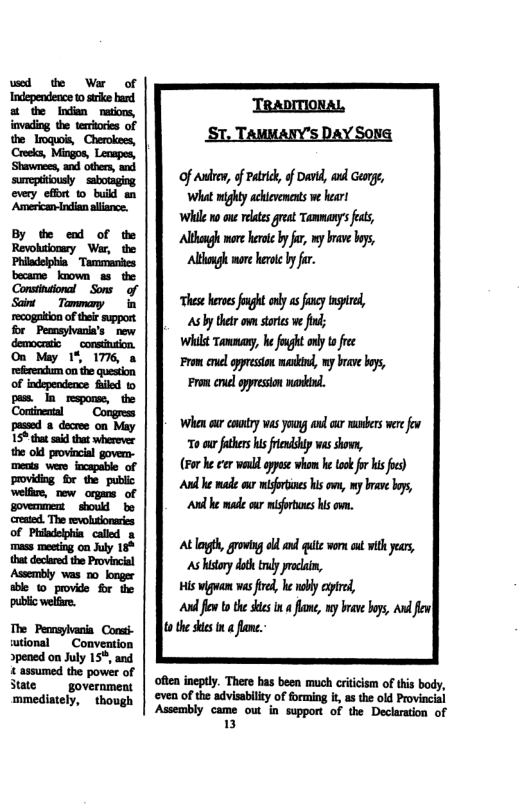
TRADITIONAL
_ST. TAMMARY'S DAY SONG
of axiror, f Pt o Davd, d G,
What ighty ackicrncis v heart
‘While no one velates great Tammany's feats,
Alhagh wore ke by fr, my bave by,
Al ware heoc by fr.
“Theseheocs gt oy s ey agie,
As by thetr own stortes we find;
Wit Tammoy, he fought only 1 fre
‘row el epreston ki, my b oy,
o el opreston manind.
When ar oty was youg o e mnbers wee o
o ur futhers s rendhly ws shom,
(For e cer vl apese whem he ook o bis o)
And e e gt his om, my v b,
Andhe e ar i W .
At oyt groving ol e worn s with years,
s ity iy i,
i wigoun ws o, b by e,
often ineptly. There has been much iticism of this body,
‘even of the advisability of forming it, as the old Provincial
Assembly came out in support of the Declaration of
13
5
‘The following year, they again marched to
Edward Pole’s country seat on_the
Schulkill, elected chiefs and performed
the Dance of the Calabash While
feasting, news arrived that_George
Washington bad Just arrived in the city,
The controversy over the United States
Constitution rallied_many Tammanites,
former Sons of Liberty, Revolutionary
War vets, and the working and middie
demanded that the Bill of Rights be
amended 1o it before they grudgingly
accepted the new Constittion. Governor
drinking several toasts, “..the revelers | Clinton of NY, a leading Tammanite and
returned to the ciy, marching Indian file, | snti-federaist, led the opposition to the
as if on aforest path.” new Consttution.
1
While both_federalists
and anti-federalists
belonged o the
Tammany Society, the
later, known as the
“Liberty Boys,” far
outnumbered the former
and dominated the
Society. From 1783
unil 1787, the “Libenty
Boys.” who were mostly
from the working and
lle classes,
dominated New York
politics. However, New
York had been & Tory
stronghold before and
during the
The New York Sute
Constitution of 1777 had
o clause i i retricting
voting rights to male
holders of _propery
valued at 100 ‘pounds,
free of all de, for the
offces of Governor,
Licutenant _Governor
and Senator, Those with
holdings exceeding 20
pounds, or paying 40
shillings annual rent,
could voe for delgates
© the Assembly. The
ich class, represented by Hamilon also hekd a moropoly
on banking, and he used that power o carce class
discpline and part loyaly.
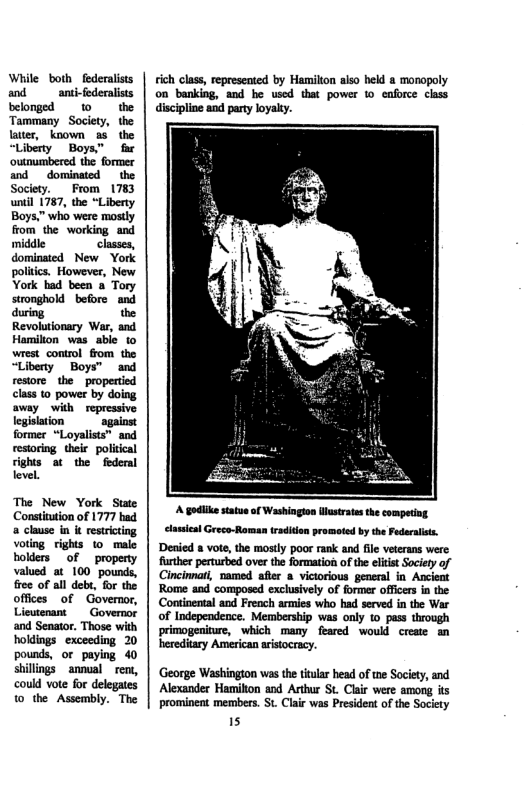
A godle statue of Washington lustrates the competing
classical Greco-Roman tradidon promoted by the Fedaralis.
Denied a vote, the mostly poor rank and file vetersns were
further perturbed over the formation of th eliist Society of
Cincinnati, named afle a victorious general in Ancient
Rome and composed exclusively of former officer in the
Continental and Freach armies who had served in the War
of Independence. Membership was only 1o pass through
primogeniture, which many feared woud creste an
hereditary American aristocracy.
George Washington was the ttular head of me Society, and
Alexander Hamilton and Arthur St. Clar were among its
promineat members. St. Clair was President of the Society
Is
the
Sociey began as_eary
I;
i1
i
Al
i
i
i
itd
|
E
EY
3
”
(the Death Song of the Cherokee ndians):
ot o ey, e
“The sn et at wigh, o te stars s te iy,
Bt glory remats when te gt ol away.
B, g tormetors, your threds are i vat,
orthe o f Al sl e conplen,
Renciber the arws e sot frm s o,
Ramenber you iy i et ad o,
Why 30, o gt 1 Sk oy pin
No,the s of ATnask sl never ompen,
Revenierthe ool where b e y,
o e cls wic w o from o ation vy,
New the e i fst, you cal n wy pat,
St the s of Aloomk sl e cnplat,
o theLondwhere myfter 5 g,
His ghet sl et the ome of s
Dot cones e i, e e fompa,
oty s, Of Aloamac, s s t complet
16
W mmm mmm m_w mm
m i E_a I
n: nzr, mm I mw
il éwz il i zm_n HLE
mrwm#. me mm ..n mm.m mm
1 “E T J;;.MK p
;E m: w iy m mmmmm% i,
”
New York Tammany Society in 1791, 1
toasts _included: “To the scourge .
aristocracy—autbor of Common Sem
and The Rights of Man!™*
In 1793, the General Society «
Mechanics and Tradesmen of New Yo
offeed 8 tonst 10 uccess for the “Armi
of France and the mechanic, Thom:
Painel” The Tammanie pow, Pl
Freneay, was inspired to write these lin.
of ribute to him:
Rous'd by the Reason of his manly page;
Once more shall Paine a listening wor
engage:
From Reason's source, a bold reform 1
brings,
By raising up mankind, he puls dov
dings.
Final rupture with the Federalists can
‘made whiskey as there was no other wi
10 get their com crop to market, West
the Appalachians, liquor served as
substitute for scarce money. They view:
the tax and unfai, discriminatory, and
deliberate attempt 1o restrict the
freedom.
‘The Whiskey rebels erected Liberty Polt
dressed in Indian costumes and present
their demand i the form of a mock Indis
treaty. Afer a federal agent was kille
Tom Paine and Revoltiorcey America, (197
Foner, Eic, p. 254,
sington seized on this as an excuse 10
alize the state miliias in Pevosytvania,
land, New Jersey and Virginia and
them agaiast the rebels in October of
. The farmers did not tempt 1 rsist,
‘ough some moved on the Kentucky and
ressce), and those who_wero aresied
convicted of ireason®® were laier
oned by Washingion.
i
]
]
i
ock on the city through control of the only
two banks, the Bank of New York and the
On Seint Tammany's Day in 1802, James
Carson delivered An Oration on the Post
ad Presen State of ow Counry in | an obstaci, and thy forced the mperais
Phildelphia, which characterized _the | 10 at least atempt 1o put & semblance ¢
indigenous people s, “the recepacie of | legality on the invasions and forced “smc
peace, happiness and conteni | of dian lands.
ment...unceguainted with thevicous habits
and evlpropensite with which Exropeans
were deeply contaminated,” who welcomed | were comroied by he lgisature. with
the Europeans, “with open arms...and | wajory captuing al votes as # bock. 1
wnbounded hosptaliy...Good God! What | swin ihe naional clecton, Burr needed
scenes of havoc, desruction and ditress | carry the New York legslative electon |
i herce nsueli" - previows spring, Bure taught 4
Tammanites t© win an clection by ar
At this time, New York’s electoral vou
means necessary. and they never forgot
* Exemplor of Liberty, . 199199 in later years adding embellishments ar
EY
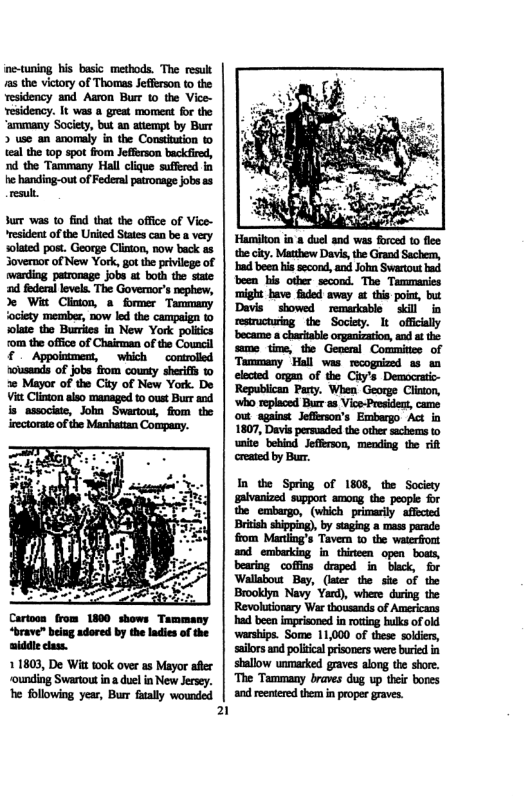
“brave” being adored by the ladies of the
iddle cass.
11803, De Witt ook over as Mayor afler
‘ounding Swartoutina duel in New Jersey.
be following year, Burr fatally wounded
21
Hamilton in'a duel and was forced 10 flee
the city. Matthew Davis, the Grand Sachem,
‘ad bee his second, and John Swartout bad
been his other second. The Tammanies
had been imprisoned in rotiog bulks of old
warships. Some 11,000 of these soklers,
salors and political prisoners were buriedin
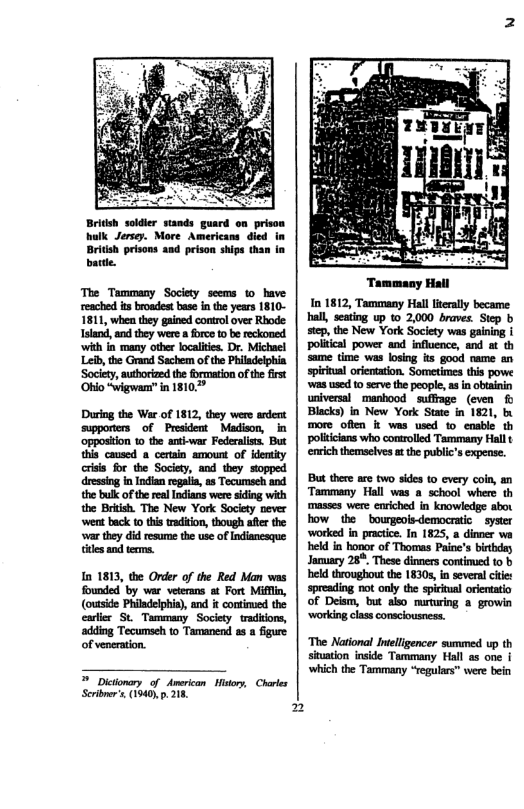
Bridah soldier stands guard on prison
Ik Jersey. More Americans died
The Tammany Society seems 1o have
reached its broadest base in the years 1810-
1811, whea they gained control over Rbode
Island, and they were a force o be reckoned
‘with in many other localtes. Dr. Michael
Leib, the Grand Sachem of th Philadelphia.
Society, authorized the ormation of the first
‘Oio “wigwanr”in 1810
During the War of 1812, they wers andent
the bulk ofthe rel Indians wer siding wich
the British. The New York Society never
‘weat back to this tadition, though ster the
war thy did resume the wse of Indancsque
ies o texm.
In 1813, the Order of the Red Man was
founded by war veterans at Fort Mifflin,
(outside Philadelphis), and it continued the
earlier St Tomemany Society traditons,
adding Tecumseh to Tamanend as a figure
of veneration.
= of Aerican Hisory, Chorles
Scribrr’, (1940, p.218.
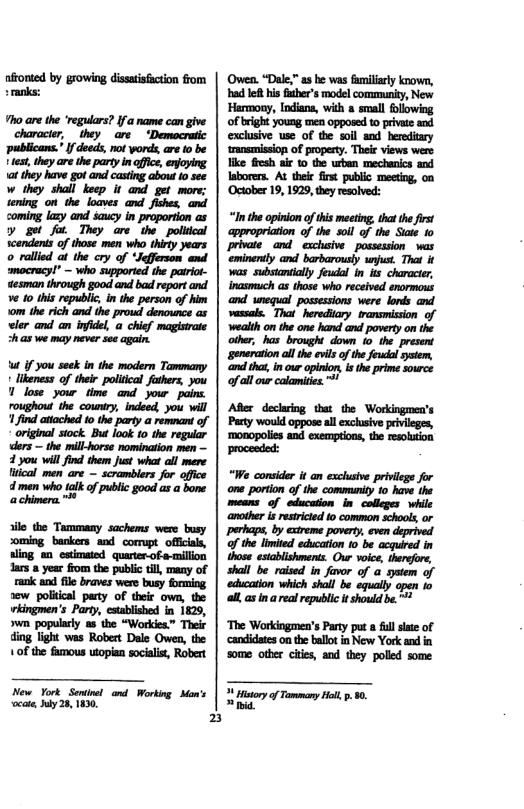
Tammany Hall
In 1812, Tammany Hall iterally became
hall, seating up 0 2,000 braves. Step b
step, the New York Society was gaining |
politcal power and influence, and at th
same time was losing its good name an
spirtual orienation. Sometimes this powe
‘s use 10 serve the people, as in obtsinin
universal - manbood suffrage (even fo
Blacks) in New York State in 1821, bt
more often it was used 1o ensble th
politcians who controlled Tammany Hall
‘enrich themselves at the publi’s expense.
But there are two sides to every coin, an
Tammany Hall was a school where th
masses were enriched in knowledge sbot
bow the bourgeols-democratic _ syster
‘worked in practce. In 1825, a dimner wa
Beld i bonor of Thomas Paoc’s bikie
Jamuary 28°. These dinners continued to b
held throughout the 1830s, in several ciie:
spreading not only the spicitual orientatio
of Deism, but also murturing a growin
‘working class consciousness.
‘The National Intelligencer summed up th
situation inside Tammany Hall as one |
‘which the Tammany “regulars” were bein
Owen. “Dale,” as be was fmilarly known,
bad let hi fher's model communiy, New
Harmony, Indians, with a small fllowing
of bright young men opposed to private and
exclusive wse of the soil and berediary
trnsmissiop of property. Theie views were
like fiesh air o the wben mechanics and
laborer. At thei firt public mecting,
‘October 19, 1929, they resolved:
“In the opinion of this meeting, tha the firs
appropriction o the soil of the Suate 10
wealth on the one hand and povety on the
other, has brought down o the present
generation althe evil o the feudl system,
‘o that, in our opinon, i the prime source
o allour colamites >
‘The Workingmen's Party put 8 full slae of
‘candidates on the ballot in New York and in
some other citis, and they poled some
3 Mty of Ty ol . 10
[
bettr education fo children o the poor and
History of Tammany Hell, p. 80, Toe sppcliaion
“indel pary” reered o the infunce of th
Deiss, the adbercs of Thomas Paie's Age of
Reason who wer prominent the movement.
" The Amerian Pa, (1947, Butrfild, Roger,
95,
‘working people. One of them wrote: “Great
wealth ought 10 be faken away from it
passessors on the same principic that a
sword or a pistol may be wrested from a
robber.” The “Workies” avowed: e are
opposed 10 Monarchy, Aristocracy,
Monopolis, Auctons, and in favor of the
Poor and asseting in.ll cases tha those
who, labour should be _protected and.
revarded: - and__final, * opposed 10
degrading the Mechanic, by making.
Mechanics of Felons. Our motto shall be
“-,M The Rights of
O
Justce and
The defection of the “Workies” cost
Tummany Haltheis majorty of sets o0 the
Common Council, and they wers foroed 0
resort 0 backroom chicancry to_maietain
Waker Brown as mayor. The Tammany
poliians were dismayed o see srength
e newcomers had musiere in wards they
had longconsidered their own. They
conchuded that t would be 8 good idea for
them to st delvering on few reforms, 50
they champiored bill 0 requie those
commissoning builling projecs © retain
o the contracior the smouat 1 be paid 10
the workers s wages, a5 it was a common
practce for_comraciors 1o “Siff” their
emporary employees once a job was dore.
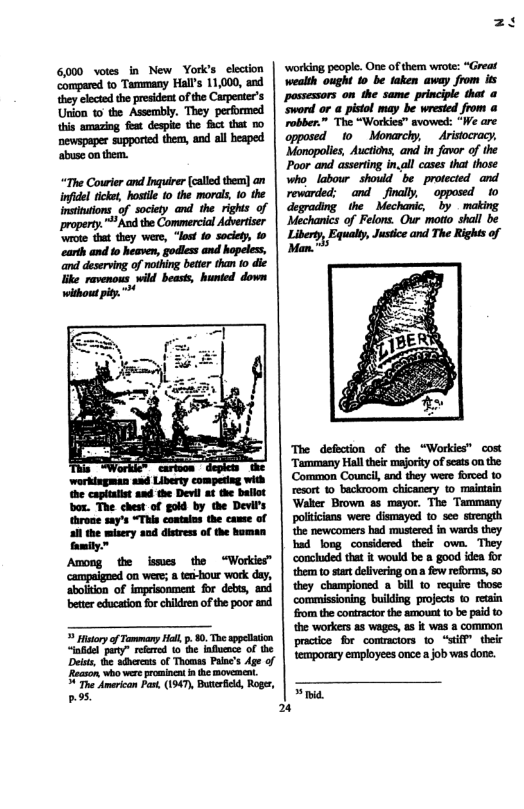
»ia.
ig2 23 mm»munmm EER L BEEE
e W
,mw.mm m.mmr.xmmim“i mmmm
E-H uud E m
mfim T me
umm wummmm m:;mnmm
i i mm [
HTHIT _mmd Hran mm
ksl T L
lifiie t petklson i o
i) o i
25
2328 > CERE m [ r.m.mu MWM 225
Sk, I
sty Em_uamhm g ]
mwmmmwmmfimh i mmm.m_mmm R,
il kil mw_r i
2 mm wm nnmm— i muum mMm w-
jt il mmm il wwm iih it
! m.wxmmrzh Mw gl 3
It thgehate SRR oL
i mmwmmmr: .m_fi i mm
i ol e
ready
10 capiulate. A wave of strkes replicaied
this vitory in cies across the county, but
the Panic of 1357 wiped out most of these
2
thirteen hoursa day. But in Philadeiphia, the
‘workers ad already begun campaigning for
the 8-hour day. In 1863, the Machinists and
Blacksmiths Union declared atainment of
the cight bour day, “the most important
change 10 us as workingmen o which all
el s subordinate.®
By 1866, the National Labor Union was
marshalliog - support for 8 naionwide
campaiga by the whole woriog class. May
17, 1867 marked a great day of struggle in
Clicago. linos b pasoed a -hour dy
law, which was to take effect on May First,
ot i comnied o clause that sid &t wouki
‘only take effbct where there was no contract
1o the contrary. On May 1%, a parade of
members of 44 unions, wih foms and
banners, and over 10,000 marchers
demanded. srct cnforcement of the vew
law. The Chicago Times called i, “The
largest procession ever seen on the streets of
Chicago.™' In many shops the workers
‘alked out afr ight hours. However, the
law was ot enforced.
I Siewad, & Boson machinis, was
credied by the socialst Labor Stadand 33
being the origostor ac author of the Eight
hour Movement.™ Steward’s theory was
that: “the habis, cusioms, and opinions of
the masses represened the sirongest power
in the world,..[and) i hours were redhced,
e leisre time wouid create new mobes
and desies. In order to satsy these nw
habes, wages would v fo move ypwards.
Change and improve the daily habits o the
laborers, and they will eise their own pay
in spite of any power in the wniverse; and
ihis ca be done by furnishing them with
more.leiure. time. Further,” Siewart
agued, *..the way outof the wage system
“mid.p 0.
i
“hi.
mmnmmm il xm i mm it g
iy mj,_fi_
m.“mm_rrm mm.mm i i il wz ili i
st aeienil! SR &
pena G s
! Wm& itz
it sl It “,_W I mm_wm mn_mmmm
f i mfizm g A
HERTTH
ili mmmfi“
i fihwmm,mm i
iy, ik :
i hitdth il
12 fim I m_m.fi: ._.m_ mm.__mmmmmd
i *w,mmmwmwmm i
A
fls et Haali it i
the words: “Your Honor, in addressing this
the millions who todl in wani and
misery...if ths is your apinion, then hang.
st Here you wil tread upon a spark, but
there and ther, bekind you and in front of
you, and everywhere, flames blze up. It is
Staion for the rde to the cemetery where.
they were buried i a commbn grave. “They
died for Liberty!” was theie epitaph.
martyrs, but 1o one was brought t justice
“ May Dy, p. 4.
strke fund 1o ensble them o stay out a3
long a8 it took © win the S-hour day
3
Tamanend's spci i sill with us. His body
is i 10 b buried by a sping throeand-
Bl mils Som Doylesiows, PA. Ancther
Tocal legend places bis final estiog pace 5.
under Nossau Hall on the campus of
Princeton Universiy in New Jerey.
Tamemany Hall is today remembered only
25 a compt institution, 8 gang of grafing
poliicians who, for & number of years,
Iid, . 4849
better serve their needs. But the cause of
social Justioe has yet 10 wina final victry.
The New Word Oder represents the
highest sod final suge of capialist
corporate
utter consempt for the rights of the common
‘people and uiter disegard for the fitwre
existence of mankind. Their sole concern s
their_sccumulation of weakh and the
‘maximization of their profits.
‘Now more than ever, we need 10 reflect on.
the legacy of Tamaneod mnd dedicate
ouselves 1o be his worhy sons and
danghters. IFhistory shows us amything, it is
that the power of the people united is the
reatest power on earth.
The Tammany Society, the “Workies” and
the “Loco Focos,” each contributed t and
passed on the legacy of liberty. The Red
Heart Wamrors Society honors _these.
‘ancestors, along with our American Indian
‘warrior sncestors ad ll who bave mutured
the tree of berty. 0
(o The Wanpun, Vol 1, No 1, Speing 1996]
Race, Ethnicity and Nationaiity in America
By Tom Big Warror, June 1, 2003
‘Because of the partcularites ane peculiaites of American history, race, ethnicity and
nationalty form complex patterns, divisions aod overlays in the fexture of American
society. First and foremost, America is 8 colosial-ettir society occupying the.
homelands of pumerous indigenous nations. These oace sovereign ations have not
disappeared, they are just under the boot-heel of the coloniabsetier society. The |
Indigenous Americans consttute an oppressed et minorty n America and are art of
the multi-ethnlc underclass of poor and working people at the bottom of American
socicty a3 well s oppressed semi-sovereiga nations.
" The colonial-settlers came from many nations in Europe, and they brought over millions
‘of kidnapped Afticans to lbor as slaves on the plantations and in the mines of America.
To n lesser degree, Asians were aiso later brought over as coolis Iborers, primarily on
the West Coast. The Europeans merged iato the white “race” in America, though many *
retained ethnic identities as German- Americans, Irisl- Americane, Jalian-Americans, and
Under conditions of slavery and segrogation, two distnct nations, one biack and one
‘white, emerged in America, particlarly n the South. Moreover, o bave any discernable:
Aftican blood-heritage t al put one inthe Black Nation. Even today, a Marish Carey is
considered 0 be a “Black entertainer,” though one must look hard o see she s not
completely “white.” James Earl Jones is considered 1 be a “Black actor,” though
recently he was hosored asthe “Cherokee Man o the Year.™
‘considered o be “white actors” in America, while Ricardo Mosteben o Cesar Romero
are “Hispanics.” | guess the difference is the accent. Geraldo Rivera “became™
“Hispanic™ afler stating his carcer as Jerry Rivers. There are Spanish-speaking Indians,
‘who do not consider themselves 10 be “Hispanics,” ike the Tainos, Aztecas, Mayans and
‘Yaquis. They have thei own langages and national identities.
In Central and Sousth America, the *Spanish” whites are the rulig class over the nov-
‘white peoples. The “Indios” people are sorely oppressed, and those who stil bave some
‘measure of tribal unity-and sovereigaty ove their lands are under sharp atack, ke the
Indians of Guatemala or Pery, where bundreds of thousands of Native American women
were forcibly steilized under the US-backed Fujimorl dictatorship:
Here in the United Staes, there js an “American” nationalty that Is inclusive of n0n-
‘whits peopl promoted:by the white power sructure, peniculely i recricment posters
forthe millry. Colln Powel is part o tis *America™ sad the white power strocture. For
purposes of clarity, 1. will introduce Lenspo. word, wapeu (meaning whie), 10
distinguish botween this America;and,the “other America” f which the Indian nations
aod the Black Naton are 8 part.
The corporations and their representatives are wapsu no matter what their ethnic
‘background. The TV news-people, the military and police are all wapsu, because that is
‘who they serve, take their pay and orders from, and think like. Actors and performers like
‘Danny Glover, Richard Prior and Chris Rock are part of the Black Nation in America.
Maumia Abu Jamal, Sundista Acol, Seth Hayes, Samusl Angel Coley and the many other
‘Black political prisoners and prisoners of war in America are visible representatives of
his Black Nasion s the oppresion it endure. It i demeaned, degraded and explried
Tike the indigenous nations.
Siace the onset of the colonization of America, the Africans in America and the Indian
nations have been each other's best allies. Long beore there was an “Underground
Railroad” to the North and Canads, the path 0 freedom or Black people led to the Indian
nations. Runsway slaves and Black Indians played significant ole in the resistance 1o
the expansion of the colonial-setter society, particularly in the Seminole Wars, which
‘were & bumiliation for the wapsu military, who could never claim a miltary victory.
Many heroes of the Black struggle, like Frederick Douglas, Harriet Tubman and Bobby
Seal, were of mixed Afican and Native American bood-teritage. ndeed, a mjorky of
Black people in America have some indigenous blood-hertage. It was not unil 1700 that
the ABican slaves outmumbered the Native American ones in North America. Under
scgregation, Indians and Blacks were ‘offen put together in the same schools and
churches.
Evea as large mumbers of Indians were froed o migrae west or were deported, small
bands of isolates formed that became tiracil in composition. These groups survived on
the finges of the wapeu socety, managiag a marginalized existence o land the whites
i not want, oftn in the swamps, pioe barrens and mountain hollers. Some, like the
‘Semiaoles, Halawa and Lumbees formed new nations out of emnant groups of ndians of
different natonaliis, Biacks and outcast whites.
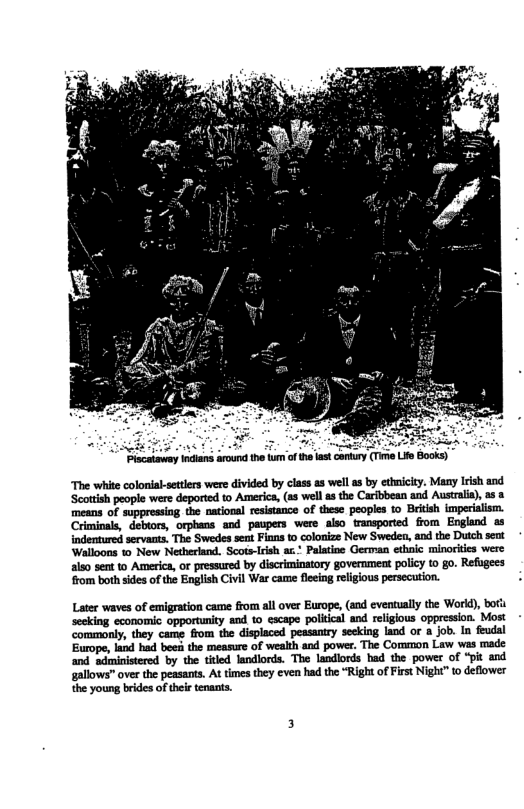
“The white colonial setlers were divided by class as wel a by ethmicity. Many Iish and
Scottish people were deported to America, (as wel the Carfbbean and Australa), a3
means of suppressing the national resistance of these peoples to British imperialism.
Criminals, debtors, orphans and paupers were aiso transported from England as
indentured servaats, The Swedes sen Fians to colonize New Sweden, and the Duch sent
Walloons 1 New Netherland. Scots-Irish a. Palatioe German ethic minorkies were
aiso sent to America, or pressured by discriminatory governmeat policy to go. Refugees
rom both sides o the English Civil War came flecing religious persecution.
Later waves of emigration came from all over Europe, (and eventually the World), boti
seeking economic opportunity and to escape political and relgious oppression. Most
commonly, they came from the displaced peasantry secking land or 1 job. In feudal
Europe, land had beei the measure of wealth and power. The Common Law wes made
and sciministered by the titled landlords. The landlords had the power of “pit and
gallows” over the peasants, At times they even had the “Right of First Night” to deflower
the young brides of thei tenants.
Even before the American Revolution, this was considered the “Land of the Free” by the
‘oppressed masses of Europeans, even as they heiped deprive the Afrcans and Native
Americans of thei freedom. But not ll white people weat along with the program. Many
sided with, intermarried with, and even fought alongside of the Native and Black people.
‘White Indians like Simon Girty, and Blue Jacket were serious opponents of the wapsu
encroschment on Indian lands.
Colonialism is a business controlled at the top by speculators, investors and benkers who
grease the poliicans 10 wilie the armed foroes and state power. Racism was their
invention s & conrol_ mechanism to maipulate the white colonial-setters 10 see
themselves s prt of “master ace” itended by God 1o exploi and oppressthe “infrior
races,”evea 0 commit genocide agains the. It was almost mandatory to build record
a5 “Indian fighter” 0 run for high political offcein America. Not ll whites embraced.
this haefil deolog, though few wer, (o ar), unaffected by it
A great deal of roe mixing ocoured because there were few white women on the
frontier. At times the goverment even encouraged it as a means of civilizing and
discouraged. Too many “go-betweens” could preseat a probiem, aa with the Metis Nation
(French-Indians) in Canads, who demanded their sovereigaty in the western proviaces
‘and fought or it
‘White captives in th Indin warsseldom waztd 1 rpaiise. Women were oppressed in
the apsu socety, and afe & taste of i in the Indian worl, thy seldom waed 1o
. leave i The military was ofien dismayed 1o fiod that the odian villagos contained more
whit and Black ceptives than Indians, who could casly run away 5 the warriors were
often gone on campaigns. When the Amercan woul-be “Tbersior” approached, they
‘would run offto the forest with the Indians or stay and help the wariors resist them.
Often the sokdiers had 10 “hogie” them 10 brin themm back 0 the wapu settements.
‘The Indians were the primary inspiration fo the early American Left. Long before the
American Revolution, the workers of Philadelphia would dow theie tols on May 1° to
celebrae “King Tammany's bonor of the Lenape:sakima, Tammeneod, who made
the Great Treaty under the elm treo with William Pena They would march single file
through the srets dressed in bomemade Tndian rogaliato thei “wigwam” on the edge of
10w, whers they sang, danced and drusmmed n the Iodian fashion and smoked the Peace
Pipe. They aiso made speeches, inthe style of ndian oratory, and drank toass to Liberty
aod the Rights of Man. '
‘Whea the Peansylvania Colony split botween support for. the Pean faunly’s Proprietary
Party and the proponeats of a Crown Coloy, the Sous of King Tammany took control of
the streets from both the Proprietary and King’s men, enabling their leader, the adopted
Lenape, Charles “Truthful Man” Thomsos, to summon the Contineatal Congress to meet
in Philadelphia. Thomson became the Secretary of the Continental Congress, which
prociaimed Tammany to be the “Patron Saint of America,” and made Mayday, “The
4
Feast of the Common Man,” the second national boliday afer July 4. Thomson steered
the Indian policy of the new republic o recogaition of the full sovercigaty of the Indien
‘Nations over the lands west of the Ohio Rive, including the right 10 form an Indian state
1 be represented in the Continental Congress, as outlined in the Pitsburgh Treaty of
7.
Many Continental soldiers and sailors fought under battle flags embiazoned with
Tamanend's totem, the colled ratlesnake, and the words, “DON'T TRED ON ME."
Others carred fiags with the Pine Tree symbol of the Iroquois Confederacy. The Sons of
Liberty in Boston and New York had street-fighting wings known as the “Mohawis.” It
‘was the “Mohawks” who were credited with dumping the tea in Boston Harbor, and other
acts of civi disobedience and riot.
This early American Left was multi-ethaic. The leader of the “Mohawks” in New York
City was & Black man known ss “The General.” Crispus Aticus, a martyr of the Boston
‘Massacre, was of mixed Aftican and Indian biood-heritage. After the war, the rank and
file veterans formed the Tammany Society in contrast 10 Washington's eltist Order of
Cincinnati, which was restricted o officers who had served in the regular Continental
Army o the French Army and theie descendents. The Tammany Socisty led the fight for
the BIll of Rights and formed the core of the Republican-Democrati Party in opposition
to Washington's Federalis Party.
‘The Tammany Society spread to many cities and towns in America and coutinued the
practioe of dressing in Indian regalia and pecforming Indian ceremonies. They supported
the French Revolution as well as rebellions against the Whiskey Tax and the feudal
landlords of the Mid-Hudson Valley, and they opposed the Indian wars. Over time, it
became mired in corrupt ciy poliics, and with the great influx of immigrants lost its
Native American orientation.
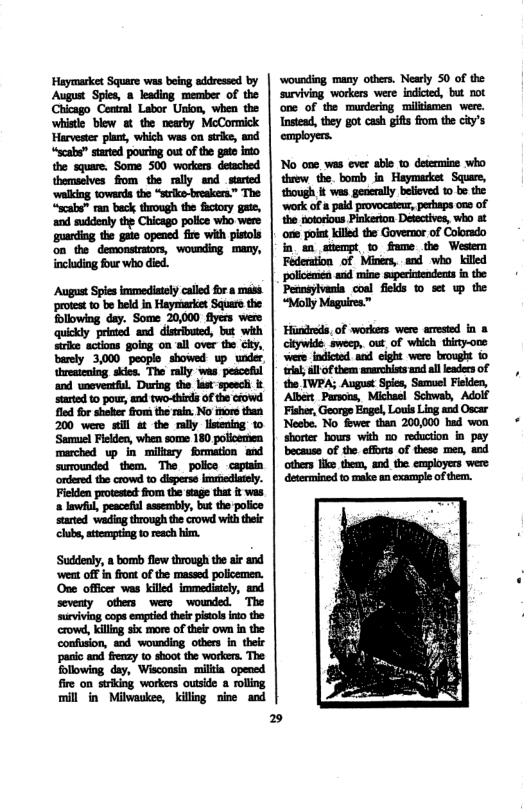
‘Scen in Desplaines Street Poce Staton, May 3, 188
5
Increasingly, May 1° became the focus of the struggle 10 shorten the workday, first 10 12
hours and then to eight. Starting in Philadelphia, the center of the movemen shifed to
Chicago, where a massive general stre was held on May 1, 1836, To provide an excuse
10 tempt to violently crush this movement and brand the workers as “terrorists,” &
police agent threw & bomb into a crowd of Chicago policemen at a rally in support of
‘stiking workers at the McCormick factory in Chicago’s Haymarke Square oo May 3"
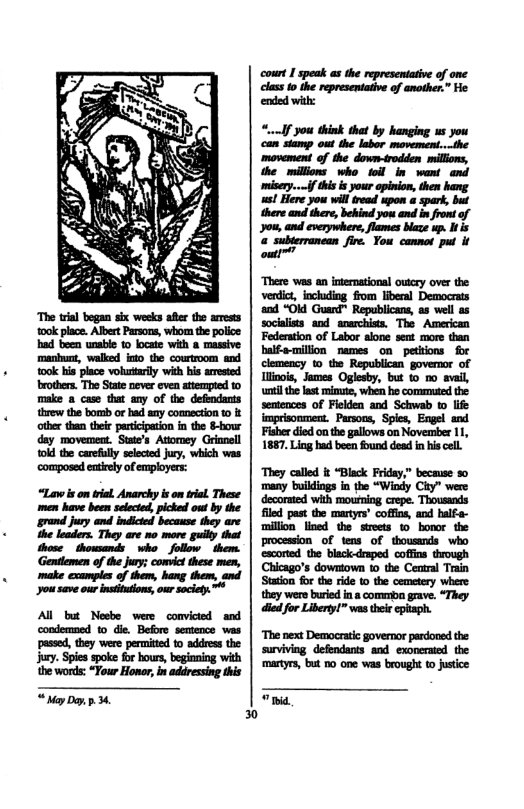
Leaders of the eight-hour day movement were charged, convicted,and hung. Bu this
cruel act of oppression backfired, and the movement grew and spread intermationally.
Mayday became “International Workers Day.”
The many campaigns of the Indian Wars were also faisely portrayed as “defeasive.”
Indian “uprisings” were provoked 1o justify breaking treaties and grabbing more land to
satsfy the demands of speculators'and- mining and railroad companies, who cut the
politcians in on the profits. Being considered an “Injun Lover,” or 8 “Niggah Lover,”
was grounds for lynching in America, as was a'Black or Indian man daring 1o look at &
‘white womas ot ook a white man n the cye.
In the Roman tradition of “Divide and Rule,”the Indian nations were played against each
other. White racism was pushed hard, © keep the Indian resistance, the Black resistance,
‘and the rising worken” movement from booking up and becoming a powerful united
o, This did not happen untilthe *60s, under the influence of the Black Panther Party
(BPP), which helped 1o launch the American Indian Movement (AIM).
Again, mundecous epression came down inthe orm of the FBI's COINTEL program of
infilaton, disruption, false prosecuion and assassioation. It was appled to the Lef
geneally, but most paricuarly to the BPP and ATM. AIM had caug the government by
surpise with the “Tral of Broken Treaties” campaign, which culminated with the
takeover of BIA beadquarters in Washington, DC by a force of 500 Indians in November
of1972.
Almost withou reslizing i, the Indian actvists had called into qustion the leghimacy of
the wapsu government. The Consttuion holds tht treaties constitate the “highest aw of
theland.” But the US government had brokea every 0ne of morethan 370 Iodian traties
From the illgal iavasion of the Ohio Terrtory uader Presideat Washingion on, the US
overnment was in volation of Intemational Law and its own Constitution.
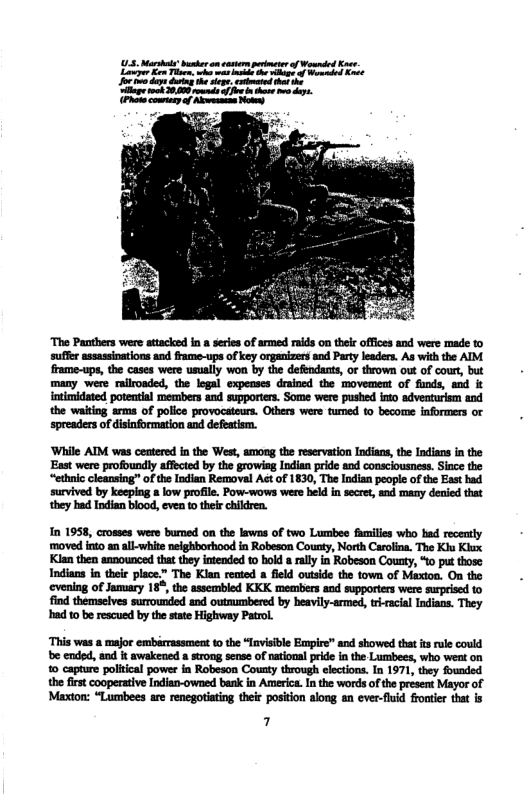
Nixon responded by drawing AIM ioto an armed confrontation on the Pine Ridge
Reservation. The FBI armed and direcied a paramilitary force on the rez who called
themselves the “Guardians Of the Ogala Nation,” composed primarily of mixed-bloods,
10 terorize and murder the Lakota traditionalists and AIM members and supporters. The
ekder called for protection from AIM warriors. Instead of going head up agains the
GOON, AIM led 2n armed occupation of the Wounded Kaee massacre it in February
of 197, This sand-off drew workiwide steation and support from the Left
internationally. Aflerwards, the governmeat launched an ntensified reign of terrr on the
ez, leading to the fame-up of Leonard Pelie in the Killng of two FBI ageats who
opeaed fireon the AIM eacamprmeat tthe Jumpiag Bull fuily ranch.
6
‘The Panthers were atacked in series of armed raids on thels offices and were made to
suffer assassinations and frame-ups of key organizers and Party laders. As with the AIM.
frame-ups, the cases were usualy won by the deféndants, or throw out of court, but
many were railroaded, the legal expenses drained the movement of funds, and it
intimidated potential members and supporters. Some were pushed into adventurism and
the waitng arms of police provocateurs. Otbers were tumed o become informers or
spreaders of disinformation and defeatism.
‘While AIM was centered in the West, among the reservation Indians, the Indians in the
East were profoundly affected by the growisg Indian pride and consciousness. Since the
“ethnic cleansing” ofthe Indian Removal Act of 1830, The Indian people of the East bad
survived by keeping & low profile. Pow-wows were held in secret, and many denied that
they had Indian blood, even to their children.
In 1958, crosses were bumed on the lawns of two Lumbee families who had recently
moved into an al. white nelghborhood in Robeson Couaty, North Carlina. The Klu Kiax.
Kian then announced that they intended to bold 8 rally in Robeson County, 10 put those
Indians in thee place.” The Klan rented field outside the town of Maxtoa. On the
eveniag of jamary 18°,the assembled KKK members and supporters were surprised 1o
find themselves surrounded and outnucnbered by hesvily-armed, rracial Indians. They
had 10 b rescued by the state Highway Patrol
‘This was & major embérrassment the “Invisible Eonpire” and showed that its ule could
e ended, and it awakened a strong sense of national pride in the Lumbees, who went on
1 capture political power in Robeson County through elections. In 1971, they founded
the first cooperative Indian-owned bank in America. I the words ofthe present Mayor of
Maxton: “Lumbees are renegotiating their position along an ever-fhuid frontier that is
7
‘characterized by cross-cultural compromise and change, Robeson's frontier bas splled
beyond the swamps that mark and bind itsinhabitants o one another through insttutions
ke the Lumbee Bank and the Universiy of North Carolina at Pembroke.”
In 1970, Wompanoag Indians led an interribal take-over of a eplica of the Mayflower in
Plymouih Harbor and paiated Plymouth Rock red. Thus beginning a tradition of
commemorating the “National Day of Mourning”™ on the wapsu Thanksgiving Day in
Plymouth, Massachusetts.
Today the aumber of people claiming Indian heritage in the East is overwhelming,
particularly among the poor whits. Many actually do have some blood-heriage, but it is
also indicaive of the growing.sense of alisnation many people foel within the wapsu
society. The capitalist politcal-economy produces & profound sense of alienstion in
‘people, on the job and in the community. Walmarts is replacing the town centrs, and
Impersonal defve-thra fht food windows and cask machines cut human contact %0 &
‘minimum.
Even the commercialized pow-wows give peopl 8 sease of community and s “spiritual
high" they don get n their hurches or neighborboods. Many of those drawn 10 these
‘events are “wannabees” or “hobbyists,” who just like to dress up in Indian regalia and
play “Indias” on the weekends, but a oumber of these “White Indians” are seriousintheic
commitmet to scve theie adopted natons.
Our lte chief, Sam Gray Wolf used o say that by the Year 2000, most of the people
born in America will have some Indian blood-heritage. He saw that the key 10 our
‘national restoration n the East was winaing these:people to identify with and become &
part of our nation. The Leaspe, like the Lumbee:and Eastern Cherokse, are a trracial
people, and have been for some time. Our stategy.must.be 10 bring togsther peopls of
diverse ethnlc backgrounds to pool their resources and live and work together for the
‘common good..
mmarmw—mmhfl.—m-fi-hh—:u-&tm
trade, allisnce, dependence, ~subjugation, dispossession, isolation,
indoctrination, flwfl*h-&.hwilfln
that sruck a maor blow 1o the natons was the.policy.of alloments of trbal lands o
private individuals. Those who had been herded onto government reservations were:
‘placed on rolls, and each was given an allotment of land to be their private property. The
mwum_u—mnmhhmmmwh
whic setemeat.
Feden i potc il fom 1870 0 o on o makia et nd elscatomof
Indians onto reservations 10 one of bresking up the reservations and puttng the Indians
under the juisdicton of federal and stae laws s individuals. According to the National
Archives and Records Administration (NARA):
On Febmary 8, 1887, Cangrss pssed the Dawes Ac, named fox ks muthr, Senater
Heary Dawes of Masachuss. Also known u the Gener Alloment Act, i law
atiowed for the resident 0 ek up resrvation land,which was beld n commcn by the
mcambers of 8 e, Into sl allnots o b parcle ot o ndvidmis. Thus, Native:
Amercan rgiacring on 8 b il wer gt aloomentsof esrvitin and. Exch
ead of ity would rceive ono-quarir of & scton (120 sy, ech sngle persc
over 18 o crphan chid wnder 18 would rceiv ne-cghth of 8 secin (60 scrs nd
‘b single prsons under 18 would rceive onsxteeth of 8 sction 00 ares).
The uapose ofthe Dawes Actsnd the subsoquent acs it cxtended s il proviions
‘was puaportely o protect Indian poperty ighs, paniclrly during the fand rushes of
e 14905, but Iy Inances e resas were vastlydiffren. The landaloted o he
Indies lacluded desert o nsr-desent Jends wnsulabe fo frming. Jn addbin, thc
i f i i v ch et o e ey o,
Many
Ao small o ffces g,
‘The Dawes Commission was organized in 1893, and applications for enrollment were
‘accepted between 1899 and 1907, with adjustments being made until 1914 on contested.
claims. This covered the Eastern nations who had been removed 1o the Okishoma Indian
Tenttory. The Guion Miller Commission for the Eastern Cherokee was approved in 1909
1 cover those who had escaped removal to_the Indian Territory. Instead of land
allotments, this commission offered snmuites to those who earolled.
‘The Indian Reorganization Act of 1934 put 8 t0p 10 allocations and sale of Indian lands,
restoring what was let 1 the nations under the trust of the federal government in what
became known as the “Indian New Deal” It didn't pan out as we thought i was going to
be." Amos Owen, Mdewakanton Sioux tribal chairman, tod historian Herbert T. Hoover
through Congress, I guess, it wasrovised bt -that buying back land was struck out of
some of the papers it was drawn up on. doa't know how this cam abous, but & wasn't
i the charter and the consitution and bylaws when the thing came into effect. So we
done i; 1 cant just go out and sey the Bureau of Indian Affairs done i. But they dida’t
believe in colonies like ours, & small community like ours buying back land
originally belonged to us anyway.”
“The goal o policy wes 0 shift the Indian popultion 1 the cte. Termination,
overt and expressd policy to asimilte th Indian nations, reached is zenih
19508, A law passed by Congress in 1953, commonly known as Public Law 280,
‘mthorzed some sates 1 extend thei cimioal laws 1o ndians on reservations nd also
E
Keanedy and Johnson, took & more liberal stance towards the issue of Indian rights than
the Eisenhower Administraion, but basically by emphasizing the position of the Indian
abandoning the strategy of termination for one of granting limited
‘Semmuel R. Cook explains in "What is Indian Self Determination* [RED INK, Vol 3,
‘Nuber o 1 My 1980
The lodian Self-Determination Act of 1975 codified the procedures for the
contracting of federal programs. Ford andCarter did licte o aler things, however,
“Reagan Revohuion” brought drstic cuts in every progm affecting Indians.
10
i3
Unemployment shot up from 40 to 70 percent in Indian communties between 1981 and
1983. Many were forced t0 sllther land rights and move offreservation t seek jobs.
In 1984, Congress passed the Indian Land Consolidation Act 1o deal with the problem of
fractionalzation of and allotment intecets stting tha inberted Intersts amounting 10
essthat two perceat would sutomatically revert o tribal ownership. Fractionalization of
‘ownership claims continues to be a major problem for reservation Indians, trbal courts
and the BIA in tempting to probate Indian estaes and maintain the Individual Indian
Monies system.
‘agencies. The US Department of Justce issued policy statement on Indian sovereigrty
and relations. It recognized that the “Indian tribes as
govemment to-government.
domestic dependent nations retain sovereign powers, except as divested by the United
States” and that forher, “the Uited Sites bas the authority 0 restore federal
recogaiion of Indian sovereigaty in order 10 strengthen tibl slf-governance.”
‘The Clinton Policy affimed that the Coosttution held that Indian reaies constinted the
“highestlaw of the and,” and tht 1) the Constiution vests Congress with plenary power
over Indian affuirs, 2.) tha the Indian rbal governmeats rtain “important sovereign
powens” over their members and territory, and 3. thatthe US bas a trust responsibility 1o
the Indian nations and tha foderal and triballaw should bave primaoy over Indian affirs.
In prticulr, Clinton championed the cause of Native spirial rights and proteting and
allowing sccess 1o sacred Indian sites. Executive Order 13007 staes that: “where
appropriate, agencies shall maintainthe conideataity of sacred sites”
'However, Clinton lost respect ffom many Indian people by allowing the FBI to intimidate:
him from keeping his campaign promise t© pardon Leocard Pelter, even as be was
leaving office in 2000. Allowing FBI agents 10 demonstrate in frout of the White Fouse
and publcly dictate presideatial policy showed both his weakness as a man aod the
‘growing power o a politcak-police state in America.
Siace January of 2001, the Indian nations have soen dramatic reversal of policy by the
‘Bush Aduinistration. Writing in Indian Country Today, Aty. Harold A. Mosteau of the
Chippowa Cree sated:
I secms tls adminisaton ls more concered wilh wiog cvryibing e ormer
‘adminiration bas doa, nstead of moviag sbead wth s own agenda. s his becase
ey do nc ave m genda or s agende ht "t lnciaaT
“This admiloation s ssingly nwillin o proec 1 sengthen o soverelgn g
5 Todian uions the way s Repablcan rekdherssought o do. Prsident Bush should
‘eplin 10 our i pecple why be Chocss 10 allow such decsons 10 be made it
ks by 1ok care ofcurslvs.
1t admniaraion wents 0 polarize sl o ndisn ousy 10 the Democrasc Pary, ks
‘cuen curse f actonill cheve that g This admiitraio s playln s dangerous
e n romotng m “a-ndies” polcy. This atitod merly emboldens cur atiude
0 smdhilic o s nthe mid-20h entury, sch actcs ed 1o the teminan e
200 ouright aack n ur bl human rghs s indigencus peopes. N
As' hlld of that e, | remember viidy he berors lndin people sullre, nthoding
‘o chlliren s our lders, o he hands f e mcaring fderl poveament, tnd &t the
hends o cy, couty and ste governments wbhen our Indie pecie were fced (o
relocate 0 fnd the e 0 e hel .
Prsident Buh, Go ot foeget e righs creaed fir Amercan lndins wndr the
‘Consituon s weates of the Unied Suts. Do sot gt the aochles commined
apins he Pt Amricns steming from culora difrnce, raca, dicriminstion
2
and e chan of broken st commited by th foders gverment ovr the past ree
Cennrie.
Do oo forge he conriion and scrfies our odia penple make 0 this cowny's
teedoms 24 heres cach snd every day, i spte of the history betwemn cur
governmens. 1 you frget thes things, we i willsuff fhom mumal disespec for
‘Whic fergivenes tnd poskive eatonscan neve b murured.
justify continbing the BLA, and the tresty rghts of the nations can be terminated once aod
for all time! By marrying the nations 10 Indian casinos, a bulli-in inceative to keep
restricting membership was crested, (sbove and beyond the anmuities), and thus limiting
the claimants for a share in the profis will hold the nations 10 this policy untilthe biter
end. Then they can shut down the casinos or “privatize” them.
This is not 10 say that the Iiberals did not have a serious desie to make sccommodations
10 the Indians, but the primary resson for making concessions was pacification and
buying time. It i the same strategy used 1o neutraize the workers' movemeat.
In the post-Civil War period, American workers were leading the international workers'
movement in the fight for the elght-hour day. The assassination of President Lincoin and
the Impeachment and near removal ffom office of President Andrew Johnson, both
orchestrted by the industrial ceptalsts, were setbacks, but the overthrow of siavery had
‘been a major gain.
The war veterans were strong i standiog up to the industral capialists, even though
unions and strlkes were considered to be “llegal conspiracies.” In the Pennsylvania
‘coalficlds, Irish miners fought with dynacite and guns after thei elected union leaders
‘were imprisoned. Inthe Railroad Strike of 1877, the Homestead Steel Strike of 1892, and
the Great Railroad Strke of 1894, armed workers fought pitched battes with Pinkertons,
scabs, polce and miltas sgaiost pey cuts od lock-outs.
Prior to WW, th Industral Workersof the Workd (TWW) emblazoned on ts banner the
sboliton of the wage system. Founded In 1905, the IWW's consiution boldly stated:
"The working class and the exploying class have nothing in common. There can be o
peace 30 long 4 hunger and want aro found among millons of working people, nd the
fow, who make up the employing class, have al the good things of lfe. Between these
two classes siruggle st go on i the workers of the world organiz as class, take
‘ossession of the carth and the machinery of productios, and abolish the wage system."
Big Bill Haywood of the Westemn Federation of Miners and Eugene Debs ofthe Railway
workers and others ke Frank Litte, who was “Balf white, half Indian, and all IWW,”
confronted the “Robber Barous” of Industry with a usion movemen that envisionsd
putting an end to exploltation not merely fighting fo shorter hours and beter wages.
WWI provided the excuse to clampdown on the Left in America, Eugene Debs was
ralroaded ioto prison for speaking out against the war, the draft and the misuse of the
B
Espionage Act to silence oppositin, but h received almost a millon votes for President
on the Soclis ket in 1920 while sl n prison. Born i the Oklahom Indian Territory
10 8 Cherokee mother, Frank Little was lynched in Montana by masked goons in the
employ of the Copper Trust. His gravestone in a Butie, Mootana, cemetery reads: *Slain
By Cipiulist Inerests For Orpanizing Aod Inspiriog His Fellow Men”
Bom in Utah in 1869, the son of a Pony
Express rider who died when he was
only three, Bill Haywood weat ito the
mines at age nine. A one-eyed giant with
a thunderous voie, young Haywood was
deeply moved by the S-bour day
movement and the execution of the
Haymarket Martys, and he joined the
Union at the first opportunity, while
working in a silver mine in Idsho. By
1900, he was a member of the Executive
‘men. Jaled on murder charges in 1906,
Haywood was acquited by an daho jury.
Wi . “Big Bi” Haywood
In 1915, “Big Bill” became Presideat of the IWW, o “Wobblies" g they were popularly
known, and led major strikes of textile workers in Massachusetts and Paterson, NJ. Some
three million workers st one time or another carried red IWW cards. The strategy of “One
Big Union” fighting fr the end of “wage slavery” struck a respoasive chord in the hearts
of the most oppressed workers and fear in the hearts of explolters everywhere.
During WWI, Haywood was arrsied undec the Sediion Act, for lading sirks, and
spent a year in Leavemwort, (where the government currntly holds Leonard Porier).
‘Whileout on appeal, he Jumped bail n 1921 and weat nto exile in Ruseia!but not before
heipng to fund the fist American Comsmunist Paty. He did in exle in 1928, Half of
i ashes were buried i the Kremiin near his iend, and fellow “Wobblc,” Join Reed,
and not f from Lenia's tomb, an um containing,the other half of is ashes was seu 10
Chicago and buried near & momument o the Haymarket anarchists who firt nspire his
lie of adicalim.
‘The “Great Depression” began with the Stock Market Crash of 1929, Overnight America
was plunged into conditions of desperate poverty as millons lost their jobs and were
"
The poliical-sconom of America had mutated i the years before WWL
American War marked the emergence of the US as an imperialist power on
age. ndusteal capialhad oerged it banking captal s become fnence capkal. Well
Sume: waa bebind both the pos-var boom of the “Rowring 20s" od the “Great
'Mhmlmfihmkmmmhhwfl.h
(h—u,mduhmh‘hn—'dhmhmmm-w
Giaic inoris, whil iberal derocrscy sought 1 make sccommodatons i them
‘and steer them towards reforms rather than revolution.
However, these were tactical differences, as both were in fact ruled by an oligarchy of
finance ‘But this was not so evident in the 1930s. WWII is what brought
America out of the “Grest Depression” Internationally, the Left aod the Liberal
Democrats made common cause to defest the Axis Powers afir the invasion of the
‘Soviet Uion. The war had a dramatic effect onthe Indian nations whose warriorsjoined
he millary servicein greater mumbers than any other ethaic group. t also bad a dramatic
‘efflct on the Black Nation, by sccelerating the move away from the Deep South to the
‘North and Califoraia to becoms industrial workers.
While Black toops were segregated,
(unlke the Tndias), s in earier wars,
they were argely kept out of combat and
put i labor batalions. Black soldiers
had fought with distnction in every war
since the Civil War, including the Indian
Wars, and those who did get to fight in
WWH, like the Tuskegee Airmen,
showed great courage. Afler WWI, the
KKK and other racst-fascist groups felt
15
greatly threatened by the returing Black combat veterans, and launched mumber of
‘anti-Black raceriots across America. The 19205 was in fact a high-tide of KKK activity.
Unlike their fascist counterparts in Burope, the KKK was not ambitious for national
‘power, They were basically content to maintain their “Invisible Empire” of cormuption
and intimidation on 8 regional basis. Politically, they were tied to the Southem
‘Democnts, who were allied with the Liberal Democrats in Washington. Had they beea
the arm of the Republican finance cepitalsts, as the Brown Shirts were with the German
Industrialists, WWII might have taken a very different tur.
1t was politcaly expedient forthe Liberal to notrock the boat down South; not uatil the
Civil Rights Movement of the Cold War era. The immediate post-war period saw a
‘sudden chilln the alliance between the Soviet Union and the Anglo-American allsnce.
Having subordinated the class struggie for the aat-fscia allisnce, the Left in America
was il prepared for the hystera of McCarthyism in the 19508 and even less prepered for
the radical upsurges among the people In the 1960s.
Auti-Commmuniem was & new religon that coud be shared by Cold War Libersls and
KKK members ailke. Throughout the Cold War, th tireat of the Sovist Uslon was
greatly hyped. Far fom bing » “ssperpower” lke the US, Russia was straining herd 10
resest crodibl deteren t atack by the West. Much of Stlin's paranoia stemmed
from the weakness of the Russians relativ 10 the surounding imperiaist workd.
‘Communism id spread, but mostly because of Soviet support o the naiona iberaton
ruggles inthecolonized Third Workd.
To say in the arms race, the Sovies resorted t0 their own brand of imperilism in their
“with other countres. Like the Liberas, the Communists couid Justify
‘with their principles because of the threat of the other side. Both sides
‘employed dual tactics, wanting 1o be seen and 10 see themaeives as the “good guys.” In
‘America, deiving the Reds out of the unions and conducting general witch-hunt, was
offet by reforms and granting concessions to the masses of people financially, and in
terms of civi ights.
Not that people did not have to fight fr these concessions, but in every fight there was
the concern to chill people out and divide them from Leftist support and leadership. Afler
several hard-fought battes 0 unionize the steel industry led by the Lefl, the Steel
‘Companies signed with the CIO without stike. They dida't want a repeat of the battle:
10 establish the UAW in the automobile plants. The red-colored countries on the geo-
politcal map gave thé Liberals clout 1o influence the Right to go along with some
democratic and economic reforms. -
Imperiaism nesded 1o present & humane fuce and psternalstic concern fo the peoples”
ights and welfre. Protest had power because the system fiared exposure, but i would
aiso use s poitcal power to pesecute those wheo proested wheneves it coukl. Leonard
Peler i a cas in poin. The government aduits it does not know who shot the two FBI
ageats, but Leonard is a symbol of rebellon against government authorty, even the
16
misuse of that power. To make an exampl of him, the FBI wants him to rot 1o death in
prison. The message being, “you cannot reist us with arms, even in self-defense.”
Inthe Post-Cold War period, Americais in & moralcrsis. Imperiaism s striniog agaiast
the constaiats of Liberal Democracy. In the ahscace of the Soviet “treat,” only world
opinion and the will of the American people resirainthe moves of the uling oligarchy of
monopoly capalists. Clearly, workd opaion means lxleto the Bush Adminisraton, and
the majority of the American people are controlled by the mass media controled by the
‘mulkinational corporations. “Liberal” bas become a dity word, and the neo-Liberals are
right ther with the Republicans tailing behind the same media poll thatare manipulated
by the Right.
‘Demonsiraton in Oskdand, Calformia sgains raq War
The “other America” bas set unprepedented recods for mass demonstrations i the past
year, and the American Left i regeneratog itslf as pat o a world-wide peace and ant-
imperiaist movement. Sl the Right and the Neo-Liberals are ploting the next war,
‘most likely against Iran, again a country with major oil aod gas reserves, which is now
bracketed between US-occupied Afihanistan and US-occupied Irag.
Like the majority of the American people, the American Left is argely ignorant of its
ndigenous roots. The contemporary American Left led by groups that came out of the
political upsurges of the 60s aad 70s, like Workers World Part, the Revolutionary
‘Communist Paty-USA, the New Black Panther Movement, MOVE, the Green Part, and
various Anarchist, Libertrian, Eavironmentalst, Black Nationalst, Feminist and other
”
formations, is composed of people of vaious ethnic backgrounds and centered primarily
‘among the youth and studeats.
indigenous peoples around the world, such s
Shining Path i Peru, and ethnic minorities in Nepal, India,
Kurdistan, and elsewhere have givea the coutemporary Left a heightened seasitivity 10
issues beyond abolition of the wage sysiem.
The busic sraiegy of the contemporary Left is a word-wide united front against
1
[
imperialism with the key alliance being betweea the struggle of the working
that of the oppressed nations and pationaites. Ironicaly, however, the
have largely remained aloof from these sympatheti potential alles, instead
hopes on the patermalism of the federal governmen. Even the rude wake-up
Bush Adminisration’s overtly antiIndian policies bas yet o fully regisier
American Indin’s consciousness.
Many fll fo the dual tactis of the Nixon Administraton “hook, line and sinker.”
drifed 1o the Right ater the occupation of Wounded Knes and forgot all
challeaging the legiimacy of the wapsu government. This is why the Let has been more:
‘consiten and vocal in demanding Leosard Pelier's rlease than the Indian naions have.
LH1
3 !%E%
i
Not long ago, I had an AIM organizer tell me that: “ladians didn’t shoot fire-arrows in
the white setlr’s roof." And of course, “Indians didu’t cross over from Asia,” despie
the oral history of the Lenape, Shawnee and other nations. A whole mythology of four
separate races;th red, white, black and yellow, has sprung up in contradicton to bistoric:
radition (and reality), which is clearly adopted from 19* Ceatury white racist ideology.
‘The existence of White Indians and Black Indians s writien out of their versions of
history, T could go on and on with examples of this historcal revisionism, which is in
essence racist and reactionary.
Everything i a8 it s because of the histoical development tha led up 10 i, cven Ifthat
history has boen covered over or is unknown by the people. Being conscious of that
history gives us an edge and greatersbily o perceive realty and affect bow things will
develop i the future. The point of isory s to make the past serve the fiture. The rle of
revolutionaries i o represent the potential fiture in the truggles of th present.
That is what we are striving t0 do in the Red Heart Warriors Society (RHWS). The wapsu
society werlve in, the New World Order, s the final and highest stage of the long Epoch
of Exploitation. This epoch began thousands of years ago In Mesopotamis, the “Cradle of
Civilzation,” when the firs selfish chief tumed from protector 10 an exploitr of his
‘people. Since then, it has been a long chain-reaction of ane system of exploitation
‘overturning another o more effctively aod profitably exploit the masses of people.
“This did not reach our people untl a fow hundred years ago with the European discovery
‘ofthe “New World” and its conquest and colonization. Our suthentic historical traditions
and. spirtual orlentation reflect this Pre-Exploitative Epoch. The science of DNA
‘mapping now tells us what the Lenape ancestors knew in their hearts, that we are all
related and descended from an original ancestress they call the “Genetic Eve.” We alk of
the “First Man and First Woman,” which of course is the same thing.
19
We talk of them descending from the “Tree of Lift,” which is & metaphor for what
actually did happen, s our ree-dwelling ancestors et the protection of the tres to stand
erect upon the ath. We are biologically related to all other ift forms on this placet, and
like all other e forms, our physical bodies are made up of the elements of the earth.
When we die, our substance retums to the earth, We believe in a ‘Giver of Life” &
“Creator,” but we do not beeve i a “Heavealy King,” or “Lord,” which s 8 reflection
of the Epoch of Exploitation.
‘We beicve that it is Creator’s ineation that we live together as & people and share the
bounty of hi blessings in peace, and that no one was itended to lod it over or exploit
another. The issues of race, ethnicity and nationaliy that divide us are of our own
invention. As fr as we have drifted from Creator's iteation, we are not completely lost,
‘we can sill fiod our way back home, beck to Crestor, We have lost our innoceace, but
‘0t our e will. We can determine to put anend to the Epoch of Exploitation, to war and
injustie and their causes. We have the means at our disposal o clminate hunger snd
‘want for all. We can take what we need ffom Nature without overtaxing the eco-system.
‘We can oace agaia stand tall upon the earh as free human beings, a3 Lenape.
INTERNATIONALIZING THE STROGGLE
by
Nathaniel Lee
We curzently live in a high-tech information era which requires
new high-tech approaches to old problems. The old street corner
sosp boxes, although still not without value, has been largely
replaced by satellite broadcasts; pamphlets are now being
supplenented by E-mail and Web pages. With changes in the vay
our world operates must come changes in the vay ve address old
concerns.
You best believe that the self-serving robber-barons on
Wall Street.and the imperialists in Washington will make the
most of this eras technological advancements. They will find
new vays to extort the masses, exploit natural resources and
dominate the world's people. Likewise we must make the best
use of these same scientific discoveries to stop them. Change
must also be made in how we operate as well. New means must
ba employed to bring together the many progressive, multitudisous
groups, each with their own special interests, into an
international fraternity where each group work togother for
for the common benefit of all. When prisoners in Graterford
send out an 808, organizers from Labor Unions, Welfare Rights
Organizations and religious bodies of various dencainations
and creeds-- in fact, all progressives forming this proposed
International progressive union around the country, despite
their particular idiosyncracies, should rush to their aid and
support. The sovereignty of each participating group need not
be sacrificed in order for such a union to ocour as some might
fear. However, our eneaies, the oppressors, ARE united and
whatever our individual or group cause, we will not stand a
snowballs chance in the Sahara if we confront a global enemy
with segmerted, divided resistance.
Activists in this new international context cannot atford
to be simply organized locally. They must establish an
international collective in order that their efforts may be
reinforced by their allies around the country. As is true with
cison based groups and confined activists. Localized voices
ure much louder and are heard much more clearly when backed
by a diverse, universal chorus of poverful groups raid in their
support. One of the reasons prisoners continue to be neglected
nd mistresated in America's Concentration Camps is that they
have no nass support base in which they can degend. Those
vho abuse thes can often do so with impunity, unafraid
of the consequences. Except in the most sensational cases,
prisoners are victimized without real remedy in the courts and
vithout adequate assistance fros local or mational prison-aide
groups. But if/vhen the prisoners in local prisons begin to
make stands that are backed by the full strength and numerical
might of outside Labor organizations, Civic groups, progressive
political parties, student unions, International Human Rights
Coalitions, and grassroots religious congregations, such stands
will be far more successful and their conditions greatly
taproved.
We cannot allow ourselves the luxury of entertaining the
foolishly false notion that we can be successful with separats
strategic struggles apart froa and excluding vital parts of
our collective. We can retain our autonomy, e can safeguard
our group sovereignty and we can continue to relentlessly
pursue our individual group agendas while simultaneously
forming larger international, perhaps global coalitions.
Our efforts, both within and beyond prison valls, must
be made international or they must fall short of their aims.
Prisoners are the most oppressed segment of American society.
They have no rights to privacy, no right to peaceably asseable,
o right to petition their governsent, no right to refuse forced
‘labor, or penal slavery, and no right to vote in most states.
Any group, and I mean any, which purports to be progressive
freedon fighters and yet do not address the most pressing needs
of the most oppressed people in America, in fact the world,
18 but deceiving themselves and their members. The real lovers
of treedom, true freedom fighters, fight for those in bondage.
It is tise to build a new International which include
Prison activis and prison activists. Lets build a working
Blueprint for future action together. I know that I can depend
upon such historically active and cosaitted groups such as the
Red Reart Warrior Society and the Black Brigade. I'm hoping
to expand our scope by incorporating others to form the First
International of Progressive Organizations.
Those who will stand against us are global, we camnot afford
to be less than international curselves.
SOUTH CHICAGO
ABC ZINE DISTRO
P.0.Box 721 Homewood, IL 60430